There won't be dancing in the streets of Guildford, outside Cycling
UK's headquarters, but the document is mildly encouraging. There is
an action plan, with a number of positive proposals in it, including
the appointment of a cycling and walking champion.
The response recognises obesity as one of the main risk factors for
disability and ill-health in the UK, costing the NHS £6.1 billion a
year. It says investment in cycling and walking is a solution to
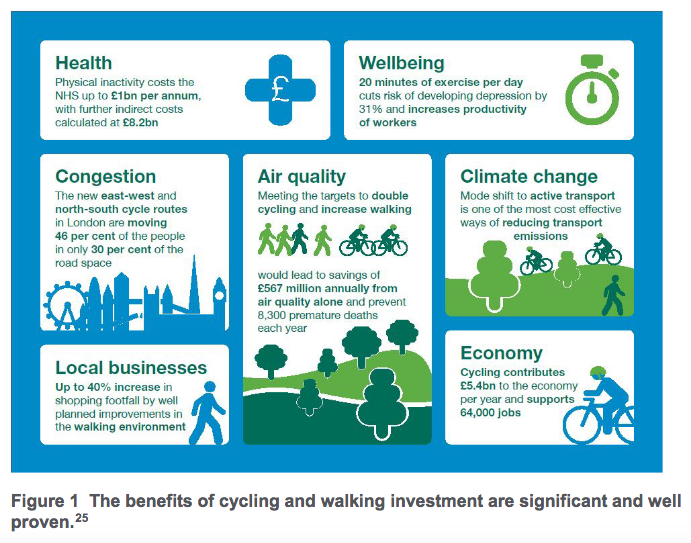
this. Cycling and walking have a number of other health, well-being,
and economic benefits.
Benefits of cycling and walking, from the DfT CWIS
response
CWIS safety review response: key themes
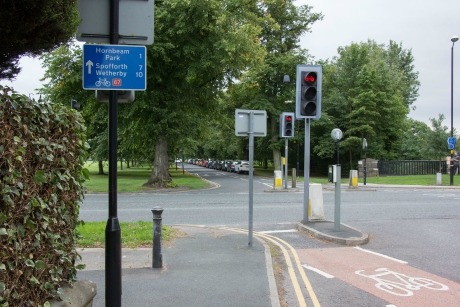
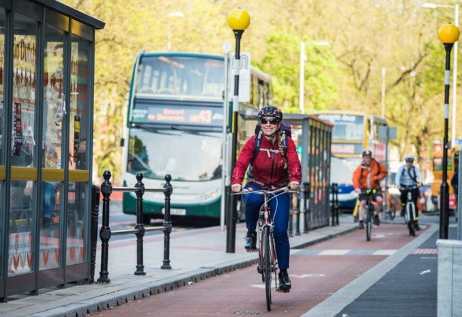
A cycle
route, Harrogate
The government response says certain key themes emerged from the
consultation.
The 'key themes' section refers to the 'Hierarchy of Road Users',
which it says is a basic principle of transport policy. It places
road users in this order:
Pedestrians, in particular those with disabilities
Cyclists
Public transport
Motorised transport
The hierarchy is the order in which to consider needs, and doesn't
mean giving pedestrians priority in every situation. If it did, it
would be failing woefully in the UK. But vulnerable road users
should be considered first. According to the DfT, [t]he response
to the Call for Evidence underlined that this may not always
occur.
The key themes section of the response accepts that [a] motor
vehicle is a large, hard and heavy machine, which can be extremely
dangerous if poorly driven. A strong theme emerging from the Call
for Evidence was the central importance of protecting vulnerable
road users from vehicles.
Close passing is also a key theme in the response. It is of central
importance to those who ride bikes on the road, and that message
appears to have been understood at the DfT.
The lack of enforcement on our roads was also raised by respondents
to the Call for Evidence, and this is acknowledged by the response.
There is a feeling that ...if a road user breaks the rules then
they are currently unlikely to be caught and deterred from
reoffending, unless they cause injury to another road user.
CWIS safety review response: no registration or licensing of
cyclists
Some respondents wanted registration and licensing of cyclists.
Generally, registration schemes are popular with people who never
ride a bike, and want to 'punish' those that do. The response
dismisses the idea, on the basis that cycling is a beneficial
activity which is unlikely to cause serious injury to other road
users.
Similarly, the DfT didn't find convincing evidence to support the
introduction of compulsory helmets.
CWIS safety review response: the action plan
Measures in the action plan include:
updating the Cycle Infrastructure Design guidance; the call for
national standards, as opposed to guidance, is rejected
strengthening consideration of pedestrians and cyclists in
Planning Policy Guidance
encouraging local authorities to spend around 15% of their
transport infrastructure budget on cycling and walking, up from
12%
exploring ways to learn from other countries including the
Netherlands and Denmark
reviewing pavement parking laws. (It is currently illegal to
park on the pavement in London, but not elsewhere in the UK)
spending £100,00 on a police back office to review video
evidence of road traffic offences submitted by the public
considering presumed liability for drivers who injure vulnerable
road users
piloting cycle training for driving instructors, including safer
overtaking
appointing a cycling and walking champion to raise the profile
of Active Travel
CWIS safety review response: the minister's comments
It is clear from Transport Minister Jesse Norman's foreword that he
has understood the case for active travel, and the challenges faced
by people who get around under their own steam. There were 14,000
responses to the consultation, and many of them were clearly
well-thought-out, and expressed firmly-held opinions forged in the
furnace that is Britain's hostile road network.
The Minister's foreword states:
'1.2 But safety has particular importance for vulnerable
road users, such as walkers, cyclists and horse riders. All road
users have an equal right to use the road, and safety and perception
of safety are key factors in determining how far people use these
modes of transport. The safer they feel, the more they will use
these active modes of travel, The more people use Active Travel, the
fitter and healthier they will be, and the more their communities
will benefit from lower congestion and better air quality, among a
host of other benefits. The logic is clear.
1.3 The impact of Active Travel on congestion is especially
important, and widely misunderstood. It is sometimes claimed that
installing cycle lanes worsens congestion, for example. In general,
however, the truth is the opposite: a properly integrated network of
cycle lanes is a far more effecient means to transport people in and
around town and city centres than the use of the same road space for
road vehicles, and due to the lower load factors involved, is far
cheaper to build.'
The consultation was a worthwhile exercise; the sentiments in the
Minister's response are right. Now - and I never thought I'd be
saying this about a Cycling Minister - we need him to stay in post
for longer than 5 minutes. We need action that creates visible and
quantifiable improvements to walking and cycling on local roads in
towns and cities throughout the UK. Ideally, we would notice those
improvements now, or at least during 2019, not in 10, 20, or 50
years' time.
CWIS safety review response: how it was received
The Cycling & Walking Alliance, an alliance which includes Cycling
UK, was pleased with some aspects of the government response.
It supports the proposed changes to the Highway Code, but was
disappointed with the absence of emphasis on speed reduction. It
wants to see default 20mph speed limits in built-up areas, and 40mph
for most minor rural roads. It is also asking for a ban on pavement
parking, and the adoption of top-quality infrastructure standards.
An alliance of health professionals has launched a report,
calling for a new Clean Air Act to reduce air pollution and the
damage it causes to our health.
A Transport Strategy for the City of London aims to reduce
traffic, prioritise walking, make cycling pleasant, improve air
quality, reduce noise, and apply a Square Mile-wide 15mph speed
limit.