'The queerest place, with the strangest people in it, leading the
oddest lives of dancing, newspaper reading, and tables
d' hôte.' That was how Charles Dickens described Harrogate
when he visited in 1858.
It is perhaps easy to see why he viewed the town as peculiar.
Dancing and newspaper reading were part of the ritual, but it was
the sulphur water that drew a wealthy clientele to Harrogate.
Despite its offensive smell, visitors would drink four or five
glasses every day.
Harrogate's fortunes had long depended on its naturally occurring
mineral waters. It was in 1571 that the first spring was discovered
in High Harrogate by William Slingsby. Riding through the Forest of
Knaresborough, his horse stumbled by a pool, and he stopped to
refresh himself with a drink. The taste reminded him of the mineral
waters he had taken at Spa in Belgium.
Realising that his discovery could be important, he had the spring
walled and paved. It became known as 'the Tewit Well', on account of
the lapwings (which the locals called 'tewits') which fed on the
mineral deposits around it.
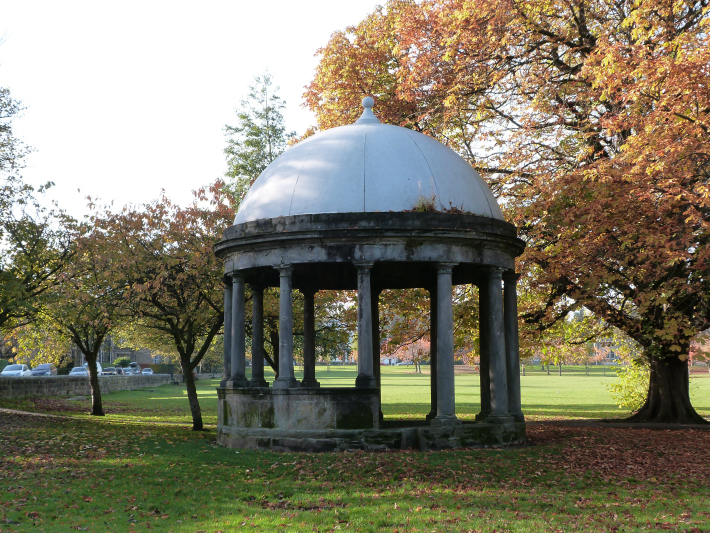
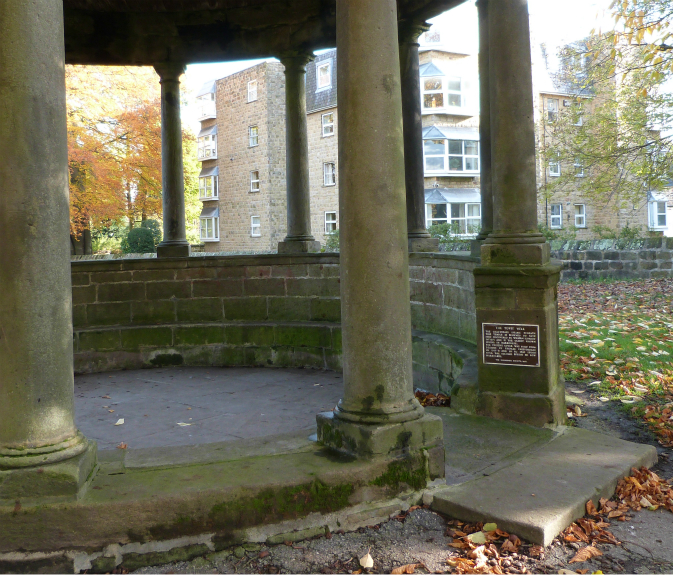
This was the first of many mineral springs to be discovered in High
Harrogate (the next being the Sweet Spa), and soon visitors flooded
in to drink the waters. The inns and lodging houses where they
stayed had wooden tubs in which guests could bathe in heated spring
water. The first public bathing house was built around 1663, next to
the Sweet Spa, under the instruction of Dr George Neale, later
author of a book about Harrogate's spa waters (Spadacrene
Eboracensis).
As well as taking the cure, they would spend time playing cards,
racing (there was a racecourse on the Stray), watching sports, and
hunting. In the evenings, they would dine and dance at the tables
d'
hôte, inns, and hotels. Harrogate became a fixture on the
social calendar, a place where many a young lady met her future
husband.
The wells in High Harrogate were 'chalybeate', or iron, springs,
but Low Harrogate had its own spring, known as the Old Sulphur Well.
The water smelt of hard boiled eggs, but stronger and more salty,
and it has always had its detractors. In the early nineteenth
century, it was described as 'the most foetid and foul-smelling
water...a nauseous puddle.'
In Tobias Smollett's novel 'Humphry Clinker', he wrote this of the
sulphur well: 'As for the water, which is said to have effected so
many surprising cures, I have drank it once, and the first draft has
cured me of all desire to repeat the medecine...The only effects it
produced were sickness, griping and insurmountable disgust. I can
hardly mention it without puking...'
Nevertheless, its medicinal properties meant that Low Harrogate
became the focus of development of the spa in the early 1800s. A
public assembly room was built by subscription in 1804 (now the
Mercer Art Gallery); a Roman-style temple was erected over the Old
Sulphur Well in 1808, for shelter from the weather; rival local
entrepreneurs built the Victoria and Montpellier Baths, and, in the
style of a Greek temple, the Cheltenham Spa Rooms, for concerts and
balls. The new facilites made Harrogate a formidable competitor
to the continental spas.
The town's prosperity was founded entirely on the waters, and when
they were threatened in December 1835, the citizens were alarmed.
Joseph Thackwray, the proprietor of the Crown Hotel, made an attempt
to divert the waters of the Old Sulphur Well onto his own land.
The other hoteliers, led by Jonathan Shutt of the Swan Inn, tried
to persuade Thackwray to stop, and when he refused, they decided to
prosecute him. He was tried in York, and acquitted on a
technicality, but the court ordered him to stop digging. The
incident led to the appointment of the Improvement Commissioners to
look after the interests of the town.
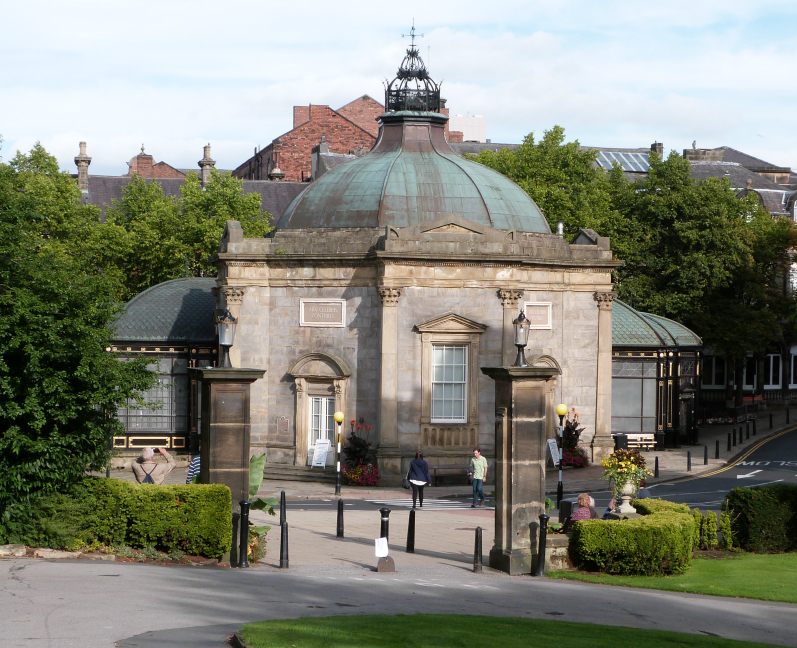
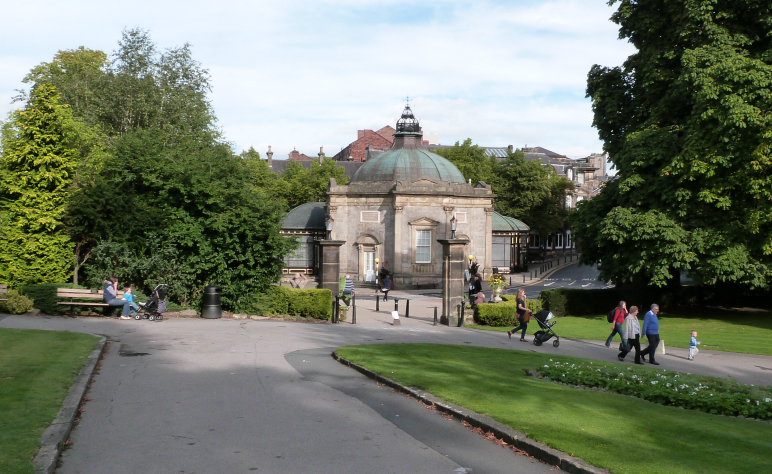
The first act of the Improvement Commissioners was to build the
Royal Pump Room, an otagonal structure to house the Old Sulphur
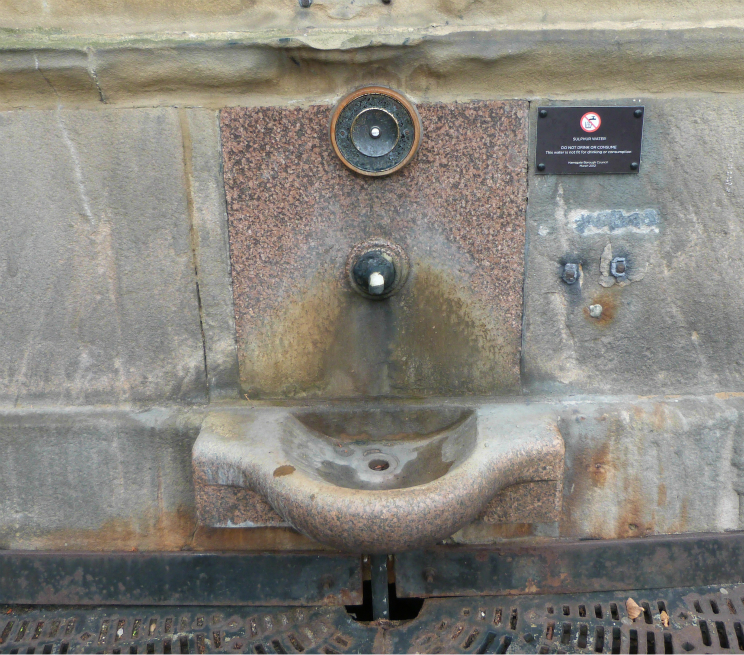
Well. An entrance fee for visitors helped to pay for it, but the
outside tap preserved a free supply for the town's poorer residents.
This free outside tap remains to this day, and is protected by Act
of Parliament. (The Stray
Act 1985 provides - section 11 (1) (c) - 'The Council shall
maintain and protect...the supply of water without charge from the
public drinking fountain situate outside the Royal Pump Room.'
In Dickens' time, visitors took two glasses of sulphur water from
the Pump Room before breakfast, with a further dose before lunch.
They would pass the rest of the morning reading the newspaper or
letter-writing, strolling in Crescent Gardens, or shopping in
Harrogate's boutiques.
Afternoon activities included cycling, golfing, or driving out to
local attractions such as Fountains Abbey or Knaresborough. In the
evenings, the fashionable guests dressed up and attended the
theatre, concerts, or a ball.
Invalids would take their treatment in one of the public bathing
houses; and from 1897, the Royal Baths provided a truly splendid
setting for a wide range of hydrotherapy treatments. None was more
bizarre than the baths where arthritic patients were immersed in
gallons of steam-heated peat!
Harrogate could justifiably claim to be one of Europe's great spas,
and it attracted celebrities from all over the world. Famous poets
who visited Harrogate's spa include Lord Byron in 1806 and
Wordsworth in 1827; in the 1911 season, royalty from Russia,
Prussia, Portugal, and Greece visited; and 1926 saw Agatha Christie
resurface at the Swan Hotel after her mystery disappearance had
sparked a major police and media search.
After World War II, Harrogate declined as a spa town, instead
developing conference facilities. Of the hydrotherapy treatments at
the Royal Baths, only the Turkish Baths remain.
For the distinctive taste of Harrogate's past, however, visitors
can still sample the waters of the Old Sulphur Well at the Royal
Pump Room museum.
All photos © Hedgehog Cycling