Cycling in Yorkshire & Beyond

Cycling in Yorkshire & Beyond
Stage 19 | Stage 20 | Stage 21

Stage 20 of the Tour de France 2026 is a 170.9km mountain stage from Le Bourg d'Oisans to Alpe d'Huez. It could be regarded as the Queen stage of the race.
Climbs include the Col de la Croix de Fer, the Col du Galibier and the Col de Sarenne before the finish at Alpe d'Huez. The total climbing is 5,450m, which is quite a lot.
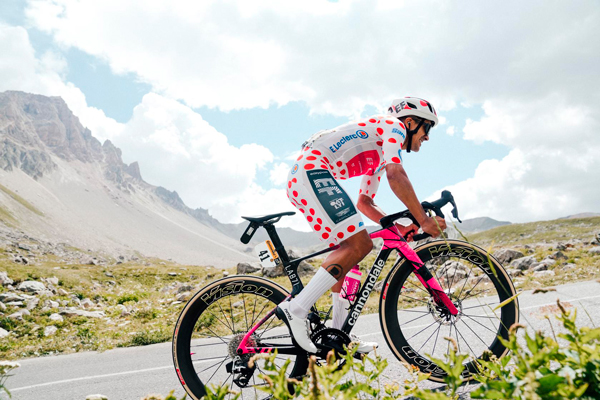
This is the race report for Stage 20 Tour de France 2026.
These are video highlights of Stage 20.
Race Details | Poll | Map & Profile | Timings | Videos | Food & Drink | Route Notes | Favourites
| Date | Saturday 25th July 2026 |
|---|---|
| Stage classification | Mountain |
| Distance | 170.9km |
| Intermediate sprint | Saint-Julien-Mont-Denis |
| Climbs | Col de la Croix de Fer (hors catégorie) Col du Télégraphe (Cat. 1) Col du Galibier (hors catégorie) Col de Sarenne (hors catégorie) |
| Total climbing | 5,450m |
Vote for one of the main contenders to win Stage 20.
This is a map of the route of Stage 20 Tour de France 2026.
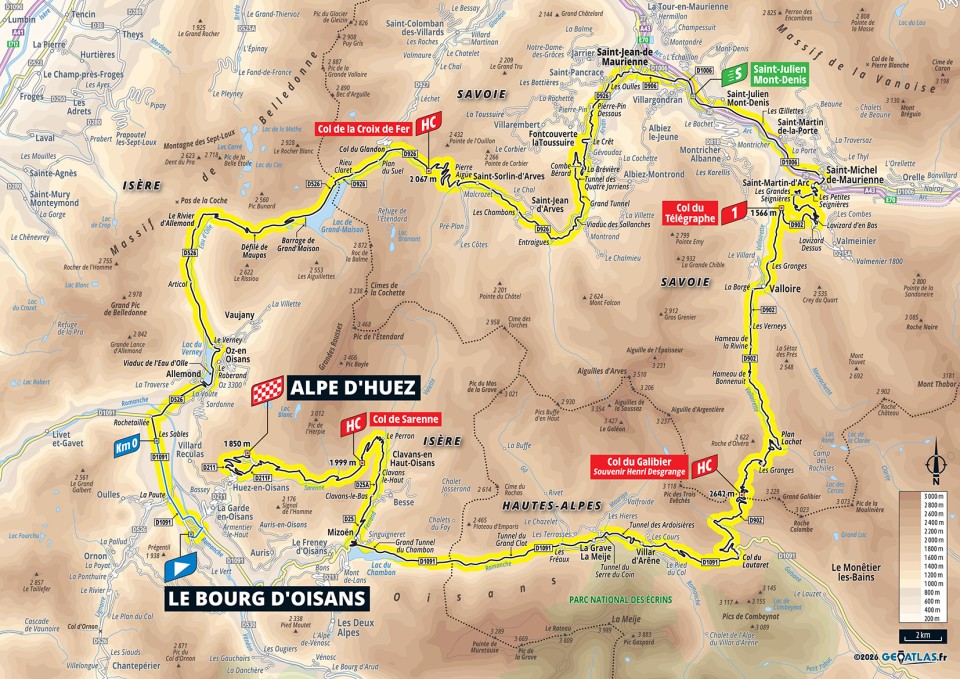
This is a zoom-able map of Stage 20 Tour de France 2026.
This is the profile of Stage 20 Tour de France 2026.

| Caravan | Fast Schedule | Slow Schedule | |
|---|---|---|---|
| Start Time (départ fictif) | 0855 |
1120 |
1120 |
| Start Time (départ réel) | 0905 |
1130 |
1130 |
| Intermediate Sprint Saint-Julien-Mont-Denis | 1118 |
1316 |
1330 |
| Col du Galibier Climb | 1246 |
1443 |
1511 |
| Col de Sarenne Climb | 1418 |
1551 |
1628 |
| Finish Line (170.9km) | 1447 |
1611 |
1650 |

Get the official Tour de France 2026 Race Guide.
The fully authorised guide includes detailed stage maps, team profiles, expert analysis and stunning photography.
Available in Standard and Premium Editions.

Get a bundle with the premium race guide, Cycling Plus Ride Like a Pro, plus socks, coasters and an allen key, for £26.38.

This is a video of the route of Stage 20 Tour de France 2026.

Stage 20 is a loop finishing in Alpe d'Huez, in the Alps. It could therefore be accompanied by heavy mountain food such as fondue, pierrade or raclette.

Vin de Savoie is usually drunk with a traditional Savoyarde meal.
Savoie wines are generally quite light with relatively high acidity. The reds are often made from Gamay grapes, and the whites from Chasselas, Altesse, Chardonnay, Roussanne or other varieties.
Apremont is one of the areas that makes vin de Savoie, generally white wine. The soil is chalky, the result of a landslide from Mont Granier in the 1200s. The slopes enable the vines to catch the morning sun. The main grape variety for Apremont is Jacquère, and the resulting wines are light and dry with floral, mineral character.
Another Savoie wine is Roussette. Buy a bottle of Roussette de Savoie (affiliate link).
The stage starts in Le Bourg d'Oisans (départ fictif).

The Stage 20 start town is Le Bourg d'Oisans.
It is a town on the Romanche river, and serves as a dormitory village for skiing in or cycling to Alpe d'Huez.
The départ réel is on the D1091 north of Bourg d'Oisans.
The riders turn off the D1091 and take the D526 by the Eau d'Olle, towards Allemond.

From Allemond, the riders begin the climb of the Col de la Croix de Fer.
After Allemond, the race passes the Lac du Verney, with the ski resort of Vaujany up to the right.
Still following the Eau d'Olle, the D526 goes through the Défilé de Maupas (with the Montagne des Sept Laux to the left).
It continues past the Barrage de Grand-Maison and the lake created by the barrage, the Lac de Grand-Maison.

The route now leaves the Isère département and enters the Savoie, which is why the road number changes from D526 to D926. Stage 20 continues through the Combe d'Olle to the Chalet Col du Glandon (which is close to the Col du Glandon itself).
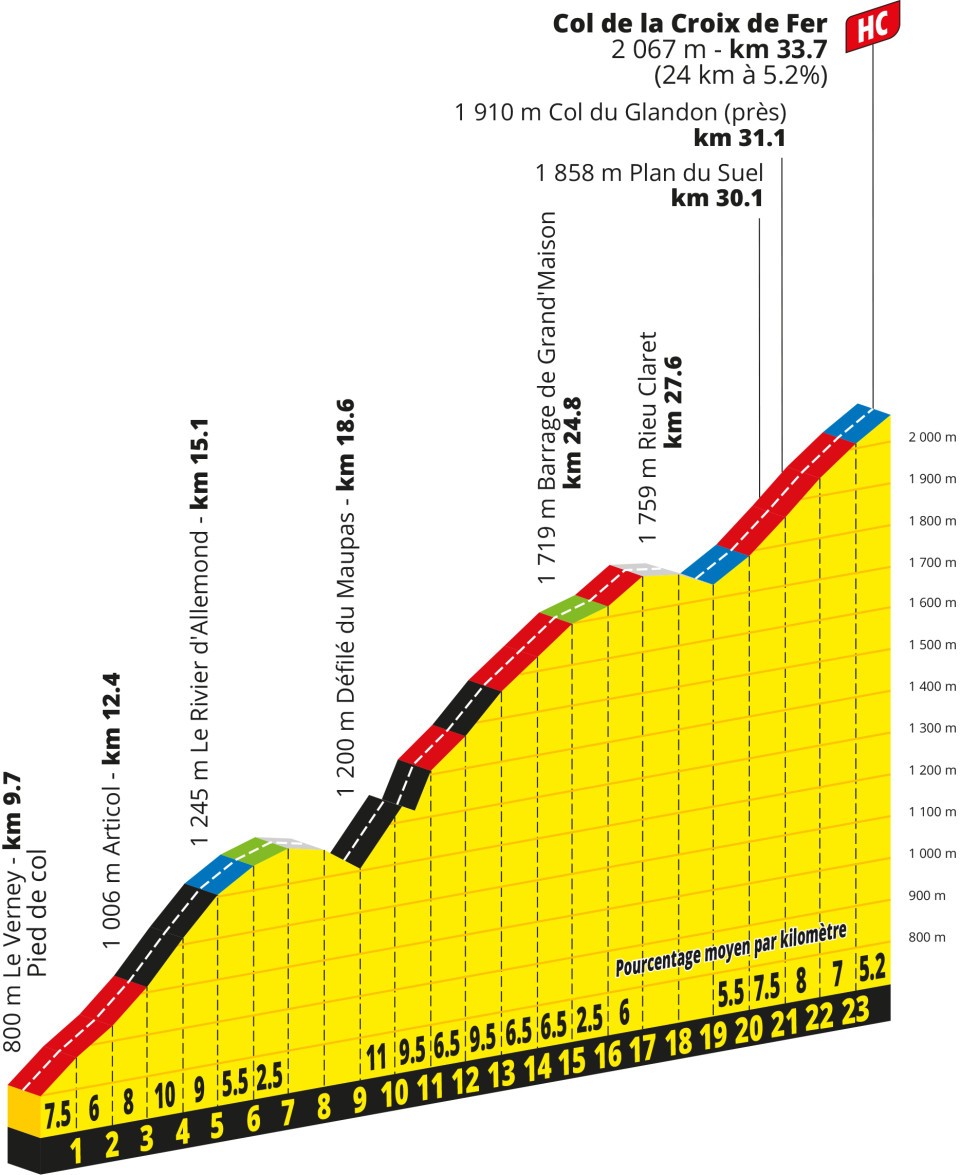
The riders stay on the D926 up to the Col de la Croix de Fer (2,067m).

The climb is 24km at an average 5.2%, to a height of 2,067m.
The descent from the Col de la Croix de Fer involves a number of hairpin bends, and takes the peloton through Saint-Sorlin-d'Arves, and past the ski resort of Saint-Jean-d'Arves.
The race reaches Saint-Jean-de-Maurienne in the Maurienne valley.

Saint-Jean-de-Maurienne is a town at the confluence of the Arvan with the Arc. It's named after John the Baptist, and reputedly had relics of John - three fingers brought back from Egypt in the C6th.
The main industries in Saint-Jean-de-Maurienne are aluminium production and tourism. Among the visitors it attracts are cyclists who use it as a base to tackle the Alpine cols nearby.
Stage 20 heads along the Maurienne valley floor by the river Arc to Saint-Michel-de-Maurienne, where the next climb begins, the Col du Télégraphe, quickly followed by the Col du Galibier.

The climb out of Saint-Michel-de-Maurienne is of the Col du Télégraphe. There are lots of twists and turns through the trees.
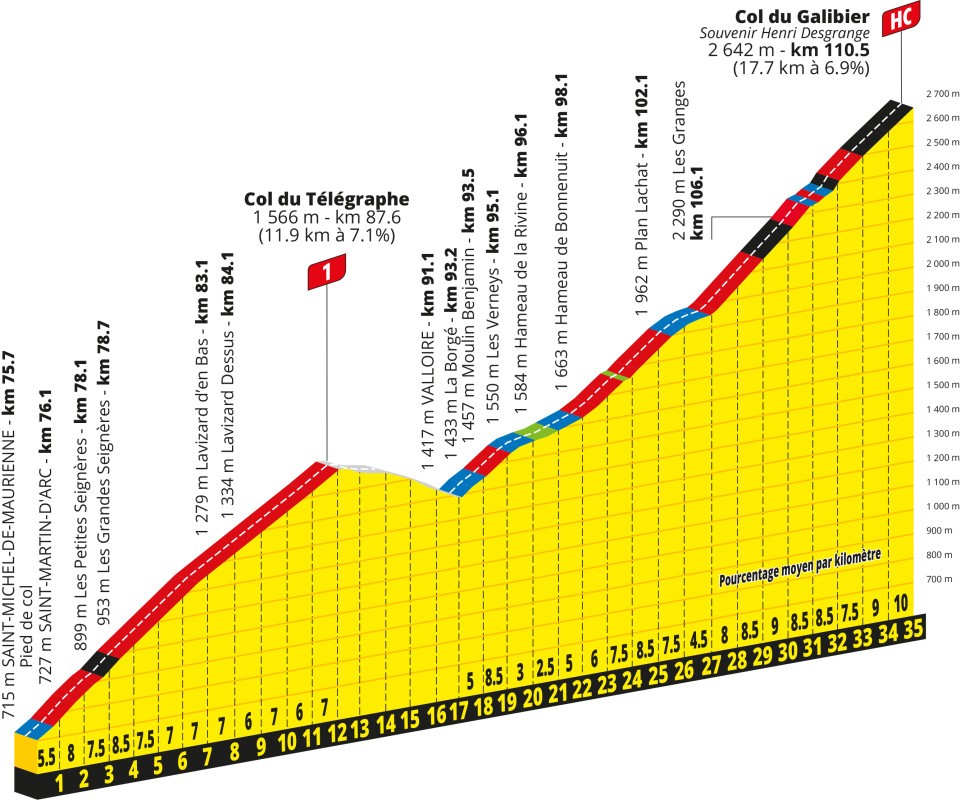
The ascent is 11.9km at an average gradient of 7.1%, to a height of 1,566m.
After the summit of the Col du Télégraphe, there's a short respite (4.5km), because the road to Valloire is slightly downhill.

Valloire is a ski resort in the Maurienne Valley and in Savoie. It is linked to neighbouring resort Valmeinier.
It was transformed from a mountain village to a ski resort in 1935-6, when the Ski Club de Paris came here.
The French Foreign Legion has a base at Valloire where recruits learn to ski.
French slalom skier Jean-Baptiste Grange is from Valloire. He was World Champion in 2011 and 2015.

As well as skiing, ice and snow sculpture competitions are held at Valloire in Winter.
In Summer, sculptors turn their attention to other artistic work - creations filled with straw and hay. Teams of two create a total of twelve giant sculptures, which you would imagine will be on display on Stage 20.
Diots de Valloire are a version of diots de Savoie sausages, with cabbage, carrot, onion and beetroot as well as beef and pork. The tourist office's recipe also includes potato, laurel leaves and juniper berries.

From Valloire, the road tilts up again, this time for the climb of the Col du Galibier.
It's relatively - relatively - gentle to begin with, and gets steeper in the last 5km, after the restaurant at plan Lachat. The average gradient is 6.9% over 17.7km.

This is the climb profile of the Télégraphe and Galibier.
The top of the Col du Galibier is also the location of the Souvenir Henri Desgrange prize in 2026.

Desgrange was the sports journalist who created the Tour de France and was its first race director. He was keen on taking the race high up into the mountains, and the Galibier was his favourite climb.
He said that all other climbs, including the Tourmalet, should take off their caps and bow before the Galibier.
He died in 1940, and in the first Tour after that (1947), the Souvenir Henri Desgrange prize was introduced.
There's a cash prize of €5,000 for the first rider to reach the prize point. It's usually the Galibier if it's on the route, and otherwise the highest point of the Tour de France.
There's a monument to the founder of the Tour de France Henri Desgrange on the other side of the col summit, by the entrance to the Tunnel du Galibier.


Skiing Made Easy is a practical guide to learning to ski based on many happy seasons of ski teaching.
It takes you through the beginner's progression from snowplough to parallel turns, starting at the very beginning and not assuming any prior knowledge.
The book suggests relevant exercises to develop and improve your skills. Common faults are identified, along with the best ways to correct them.
'By the way' sections contain information about many of the little things that people assume you just know, but you may not.
'This is the book I wish I'd had when I started skiing' - reviewer on Amazon.
How to buy:

Skiing Made Easier is the follow-up to Skiing Made Easy, and picks up from where the first book left off.
The first chapter is Refining Your Parallel Turns.
The chapters on ski technique beyond basic parallel turns are Carving, Short Turns, Bumps and Off Piste.
There are then further chapters on Avalanche and Mountain Safety, Ski Psychology, Physical Preparation, Ski Servicing and Alpine Wildlife.
As in Skiing Made Easy, common faults are identified and exercises suggested to correct them and to develop your skills.
'By the way' passages contain bits of skiing knowhow that could otherwise take years to pick up.
How to buy:
The Amazon URLs are affiliate links.

The descent from the Galibier is to the Col du Lauteret.
There, the riders turn right on the D1091 to La Grave and the Lac du Chambon/Barrage du Chambon.

The climb of the Col de Sarenne starts at the village of Mizoën.
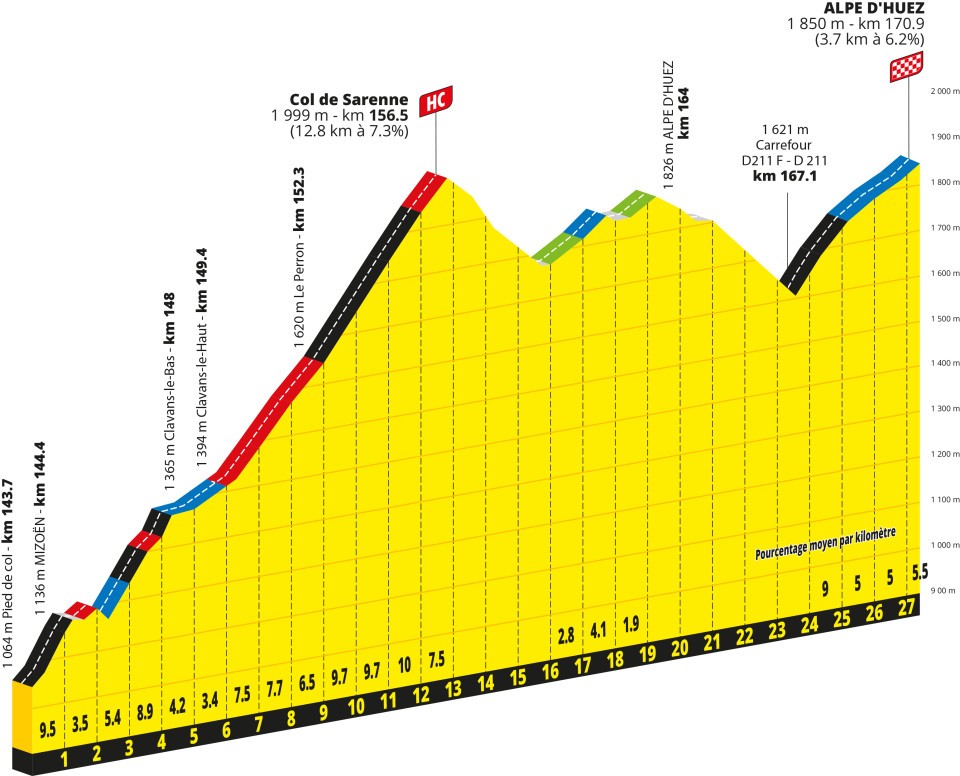
The final climb on the stage is the Col de Sarenne, which is 12.8km at 7.3% to a height of 1,999m.
It is reached after 156.5km raced, with another 14.5km still to race. The parcours is up and down on the way to Alpe d'Huez, passing the Altiport.

Stage 20 finishes with a bit of uphill. This is the climb profile of the Col de Sarenne and the final kilometres to Alpe d'Huez.

Alpe-d'Huez is a ski resort in the Isère département of France.
It was developed from the 1920s, and the first button lift (made by Jean Pomagalski and his Poma lift company) was installed in 1936. Alpe-d'Huez hosted the bobsleigh events of the 1968 Grenoble Winter Olympics.

Favourites for Stage 20 of the 2026 Tour de France include the best climbers like Pogacar, Vingegaard and Lipowitz.
Richard Carapaz might target this stage.
Who do you think will win Stage 20 of the 2026 Tour de France?

Science in Sport 800ml water bottle, price £2.50 from Amazon at the time of writing (affiliate link).
As an Amazon Associate, I earn from qualifying purchases.

Bike Rides in the Yorkshire Dales is available in colour paperback.
Find out more about Bike Rides in the Yorkshire Dales or buy a copy.

Bike Rides In and Around York features a historical city tour, plus family rides, road rides, and mountain bike rides.
Find out more about Bike Rides In and Around York or buy a copy.

Bike Rides in Harrogate and Nidderdale is a book of family, mountain and road bike rides.
Find out more about Bike Rides in Harrogate and Nidderdale or buy a copy.

Find out more about Mountain Bike Rides in the Yorkshire Dales.
Buy Mountain Bike Rides in the Yorkshire Dales at £8 + P&P.

Garmin Edge Explore, £197.99 at the time of writing.
Garmin Edge Explore on Amazon (affiliate link).

Faster by Michael Hutchinson on Amazon (affiliate link).


