Cycling in Yorkshire & Beyond

Cycling in Yorkshire & Beyond
Stage 17 | Stage 18 | Stage 19

Stage 18 of the Tour de France 2026 is a 185.2km mountain stage from Voiron to Orcières-Merlette.
Orcières-Merlette was where Luis Ocana won in 1971, defeating Eddy Merckx by a big margin. Primoz Roglic won here on Stage 4 of the 2020 Tour de France.
In 2026 this could be a day for the breakaway with a GC battle behind (or the GC battle might also be the contest for the stage win).
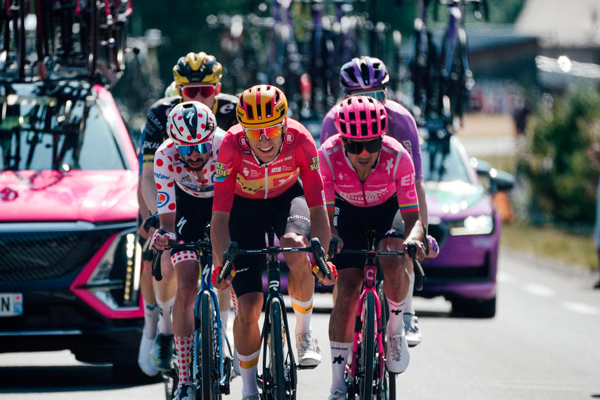
This is the race report for Stage 18 Tour de France 2026.
These are video highlights of Stage 18.
Race Details | Poll | Map & Profile | Timings | Videos | Food & Drink | Route Notes | Favourites
| Date | Thursday 23rd July 2026 |
|---|---|
| Stage classification | Mountain |
| Distance | 185.2km |
| Intermediate sprint | Corps |
| Climbs | Côte d'Engins (Cat. 1) Côte de Monteynard (Cat. 2) Côte des Terrasses (Cat. 3) Côte de Saint-Léger-les-Mélèzes (Cat. 3) Orcières-Merlette (Cat. 1) |
| Total climbing | 3,900m |
Vote for one of the main contenders to win Stage 18.
This is a map of the route of Stage 18 Tour de France 2026.
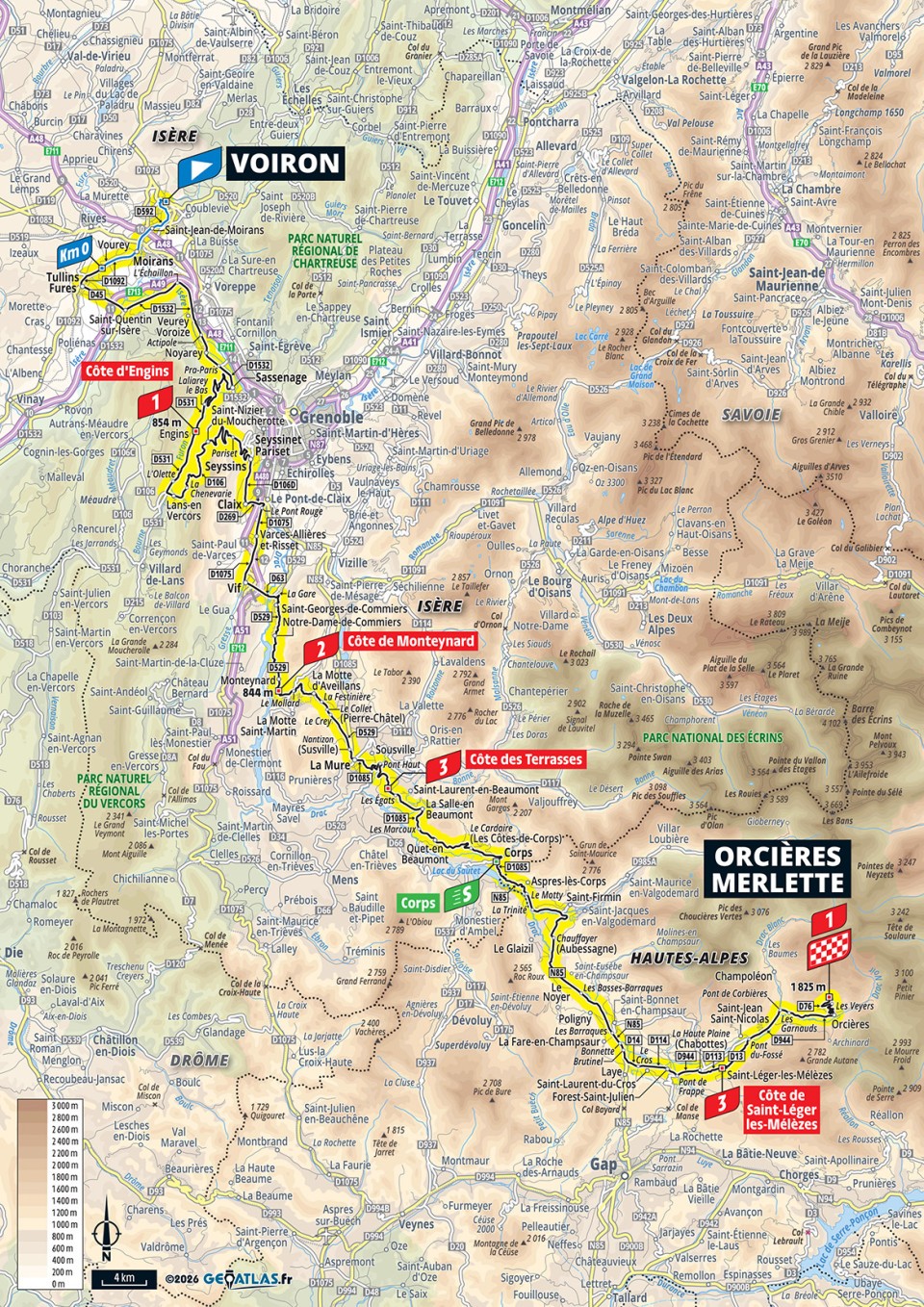
This is a zoom-able map of the route of Stage 18 Tour de France 2026.
This is the profile of Stage 18 Tour de France 2026.

| Caravan | Fast Schedule | Slow Schedule | |
|---|---|---|---|
| Start Time (départ fictif) | 1010 |
1235 |
1235 |
| Start Time (départ réel) | 1025 |
1250 |
1250 |
| Côte de Monteynard Climb | 1308 |
1505 |
1520 |
| Intermediate Sprint | 1413 |
1554 |
1613 |
| Côte de Saint-Léger-les-Mélèzes Climb | 1518 |
1641 |
1706 |
| Finish Line (185.2km) | 1552 |
1712 |
1740 |

Get the official Tour de France 2026 Race Guide.
The fully authorised guide includes detailed stage maps, team profiles, expert analysis and stunning photography.
Available in Standard and Premium Editions.

Get a bundle with the premium race guide, Cycling Plus Ride Like a Pro, plus socks, coasters and an allen key, for £26.38.

This is a video of the route of Stage 18 Tour de France 2026.
This video shows Luis Ocana winning at Orcières-Merlette in 1971.

Stage 18 is in the southern French Alps.
Specialities of the Alps are often heavy dishes with a lot of cheese or cream. Tartiflette is no exception. It is made with potatoes, reblochon cheese, lardons and onions.
The name reblochon comes from the verb reblocher, to milk again. This practice developed as a way of avoiding rent to the landowner, since the sum payable was based on the amount of milk a herd produced. The second milking was only done after the amount of milk produced had been measured.
The second milking produces a richer milk, used to make reblochon cheese.
Vin de Savoie is often drunk with a traditional Savoyarde meal. The relatively high acidity is said to go well with cheese-based dishes and help digest them. Vin de Savoie is not the very best wine France can offer, though.
Sancerre, on the other hand, is reliably delicious.

Sancerre is an AOC wine region in the eastern Loire valley, not far from Orléans. It is made primarily with Sauvignon blanc grapes. The result is a dry but aromatic wine, with intense flavours of peaches and gooseberries.
Buy six bottles of Sancerre (affiliate link).
The stage starts in Voiron (départ fictif).

The Stage 17 finish town is Voiron, in the Isère département and close to Grenoble.
It is regarded as a gateway to the Chartreuse mountains.
Traditionally, Voiron produced canvas from hemp. In the 1800s, it switched to making silk.
The Rossignol ski company was founded in 1907, and migrants from Italy were amongst its workers.
The Chartreuse Distillery is in Voiron, continuing the tradition of making Chartreuse liqueurs to a recipe developed by the monks of Saint-Pierre-de-Chartreuse. The distillery is a popular tourist destination.
Voiron is twinned with Droitwich Spa.
The départ réel is on the D1092 south-west of Voiron, between Vourey and Fures.
The race takes the D45 Route de Saint-Quentin, crosses the Isère, and reaches Saint-Quentin-sur-Isère. Then it's on the D1532 Route de Grenoble, following the Isère towards Grenoble.
Instead of going into Grenoble, Stage 18 stops short at Sassenage.
Sassenage is known for its 17th century château, its caves (les Cuves de Sassenage) which are one of the Seven Marvels of the Dauphiné, and its Vercors-Sassenage blue cheese.

From Sassenage, the race climbs into the Vercors on the D531. This is the first categorised climb.
The Côte d'Engins is a climb up the Gorges d'Engins to 854m.
It's 11.4km at an average 5.4%.

The Vercors takes its name from the first known inhabitants here, the Vertacomicori, a Celtic people.
It is a Regional Natural Park, created in 1970, and covering an area of 432,000 hectares. It is a high, limestone plateau, covered with beech and conifer forests, and dissected by deep river gorges. It's form makes it a natural fortress, which enabled the Vertacomicori to live free of Roman domination.

There are over 1,800 plant species, and the six species of wild hoofed animals found in France (chamois, red deer, roe deer, wild boars, moufflons, and ibexes). Birds of prey here include golden eagles, peregrine falcons, Bonelli's eagles, and vultures.
Bears (European brown) were last seen in the French Alps near Saint-Martin-en-Vercors in 1937, since when they have disappeared, largely due to hunting by man. Bears are ominivores that search for food in remote and steep wooded areas. The Haut Vercors is deserted in winter, and would provide a perfect habitat for bears if they were re-introduced.
There are five nature trails in the Vercors, and it is a paradise for cross-country skiers. It's also one of the top places for potholing in France.
Pont-en-Royans sits on the river Bourne, which divides the Vercors in two: the Montagne de Lans to the north, which is more developed, and the 'real' Vercors to the south, which is densely forested and quite isolated.
The Vercors is known as a stronghold of the Resistance during World War II. It is a natural fortress, to which access can be controlled. From 1942, several Resistance camps were established. Pierre Dalloz devised the plans Montagnards, an idea for establishing an Allied bridgehead in the Vercors: 'There is a sort of island on terra firma, meadows protected by a wall of China. There are few access routes, and they are narrow and rocky. One could bar them, assemble batallions of parachutists on the plateau, then the Vercors could fall on the enemy's rear.'
The plan was partly implemented. The BBC broadcast the message le chamois des Alpes bondit, which was the signal for the Resistance to seal off the Vercors. They did so on 9th June 1944. The Allies dropped armaments to the Resistance, but not troops.
On 3rd July, the Vercors Republic was proclaimed. On 21st July 1944, 15,000 German Alpine troops, plus Commandos and SS soldiers, engaged in fighting with the Resistance. After two days of fierce exchanges, the Resistance was defeated, and the survivors dispersed. The German troops massacred civilians and carried out summary executions in local villages. The reprisals continued for weeks.
The riders reach Lans-en-Vercors before trickling down the hairpins of the D106 through Saint-Nizier-du-Moucherotte to the Grenoble suburb of Seyssins.
Next on the route is Claix, then the race passes two hillocks - Le Grand Rochefort and Petit Rochefort.
The race continues to Vif. It was the start town of Stage 18 Tour de France 2025.

Stage 18 starts at Vif, which is a little town just south of Grenoble in the Isère département.
It is home to the Champollion Museum, which presents the daily life of Jean-François Champollion, who lived in the house and discovered Egyptian hieroglyphs.
A cement company called Vicat was founded in Vif.
After crossing the Drac, Stage 18 goes through Saint-Georges-de-Commiers and Notre-Dame-de-Commiers.
It climbs to Monteynard, which is the next categorised climb.
The Côte de Monteynard is 9.7km at 5%.
There's more rolling road on the way to La Motte-d'Aveillans and La Mure.

La Mure is a town on the plateau de la Matheysine, in the Isère département of France.
The name La Mure comes from a pre-Celtic root, mor or mur, meaning rocky promontory or hill. The town's name therefore derives from the rocky hill on which the first castle was built here, and has nothing to do with blackberries or ripeness (other meanings of the word mure in French).
La Mure is known for being on the Route Napoléon - the road Napoléon Bonaparte took on escaping from his first exile on the island of Elba, in the Mediterranean. (This period was Bonaparte's Hundred Days, which ended with defeat at Waterloo, and exile for a second time in the south Atlantic, on Saint Helena).
In summer, a tourist train runs on the line formerly used to transport coal mined in La Mûre to Saint-Georges-de-Commiers.

Skiing Made Easy is a practical guide to learning to ski based on many happy seasons of ski teaching.
It takes you through the beginner's progression from snowplough to parallel turns, starting at the very beginning and not assuming any prior knowledge.
The book suggests relevant exercises to develop and improve your skills. Common faults are identified, along with the best ways to correct them.
'By the way' sections contain information about many of the little things that people assume you just know, but you may not.
'This is the book I wish I'd had when I started skiing' - reviewer on Amazon.
How to buy:

Skiing Made Easier is the follow-up to Skiing Made Easy, and picks up from where the first book left off.
The first chapter is Refining Your Parallel Turns.
The chapters on ski technique beyond basic parallel turns are Carving, Short Turns, Bumps and Off Piste.
There are then further chapters on Avalanche and Mountain Safety, Ski Psychology, Physical Preparation, Ski Servicing and Alpine Wildlife.
As in Skiing Made Easy, common faults are identified and exercises suggested to correct them and to develop your skills.
'By the way' passages contain bits of skiing knowhow that could otherwise take years to pick up.
How to buy:
The Amazon URLs are affiliate links.
From La Mure, the race is on the N85/D1085 Route Napoléon to La Salle-en-Beaumont.

The Route Napoléon is the road Bonaparte followed after leaving Elba in February 1815.
Bonaparte was sent to Elba in April 1814 and a Bourbon King, Louis XVIII, restored in France. By February 1815, many of Bonaparte's old soldiers were disgruntled with the new arrangements.
Napoléon left Elba at the end of February 1815 and landed on mainland France near Antibes, on the south coast.
'I will arrive in Paris without firing a shot', he exclaimed. He headed north west on a bad road to Grasse, Digne-les-Bains, Sisteron and Gap, intending to pick up recruits on the way. This road is what is known today as the Route Napoléon.
Continuing on his way, he was welcomed in Grenoble and Lyon, and made it to Paris by 20th March 1815.
This led to Napoléon's final defeat at Waterloo, and subsequent exile to St Helena.
Soon after La Mure, the riders tackle the Côte des Terrasses.
The Côte des Terrasses is 3.4km at 6.6%.
The race continues to the Lac du Sautet and Corps.

The Lac du Sautet is a manmade lake, created between 1930 and 1935 by a barrage of Le Drac. Hydro-electric power is produced here.
The Pont du Sautet overlooks the barrage.

The lake has a water sports centre and a beach.
The intermediate sprint takes place at Corps, overlooking the Lac du
Sautet, after 129km raced.
Still on the Route Napoléon, Stage 18 goes through Chauffayer.

The race continues to Saint-Bonnet-en-Champsaur and La-Fare-en-Champsaur.

The race finally leaves the Route Napoléon, taking the D114 to Forest-Saint-Julien then the D944 to Chabottes.
From Chabottes, the race is on the D113 to Saint-Léger-les-Mélèzes. This is the next climb.
The Côte de Saint-Léger-les-Mélèzes is 2.5km at 6.9%.
From there, Stage 18 is on the D13 Route du Baille to Pont-du-Fossé, then the D944 Route d'Orcières alongside the Drac to Orcières.
That just leaves the final climb.
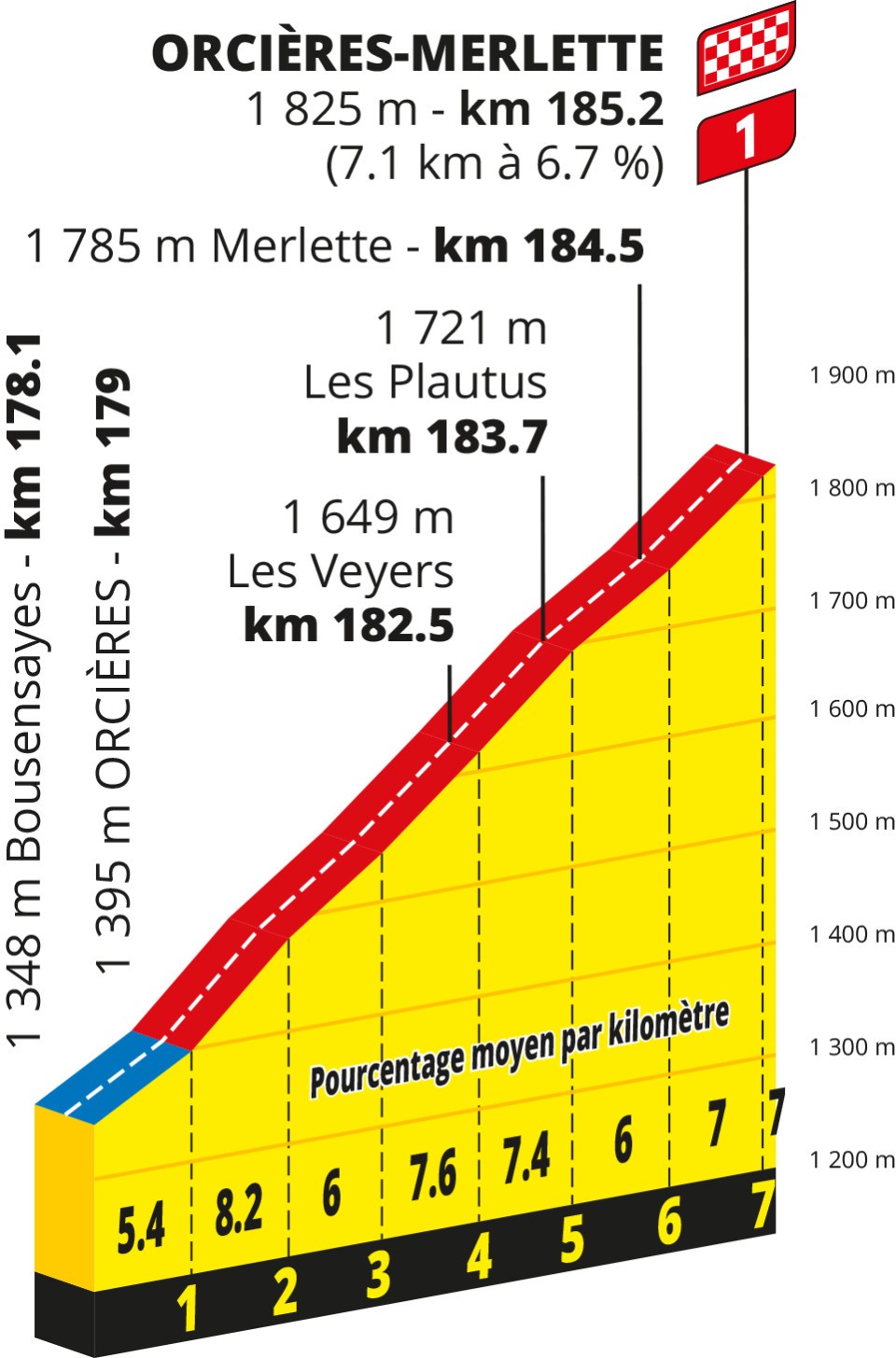
Stage 18 finishes at Orcières-Merlette.
There are ten hairpin bends from Orcières to Orcières-Merlette. The climb is 7.1km at 6.7%.

Orcières-Merlette is a ski resort at 1,850m.
It has featured in a number of Tours de France, including the finish of an ITT on Stage 15 Tour de France 1989, won by Steven Rooks.
Stage 4 of the 2020 Tour de France finished here, a stage similar to today's. Primoz Roglic won that day.

Favourites for Stage 18 of the 2026 Tour de France include the climbers who are no longer in GC contention, and are therefore allowed to go in the breakaway - think Richard Carapaz.
Perhaps Lenny Martinez will be on an exceptional day.
Alternatively, UAE might ride any breakaway down to set up a win for Pogacar.
Who do you think will win Stage 18 of the 2026 Tour de France?

AUNNO Universal Travel Adaptor, price £15.99 from Amazon at the time of writing (affiliate link).
As an Amazon Associate, I earn from qualifying purchases.

Bike Rides in the Yorkshire Dales is available in colour paperback.
Find out more about Bike Rides in the Yorkshire Dales or buy a copy.

Bike Rides In and Around York features a historical city tour, plus family rides, road rides, and mountain bike rides.
Find out more about Bike Rides In and Around York or buy a copy.

Bike Rides in Harrogate and Nidderdale is a book of family, mountain and road bike rides.
Find out more about Bike Rides in Harrogate and Nidderdale or buy a copy.

Find out more about Mountain Bike Rides in the Yorkshire Dales.
Buy Mountain Bike Rides in the Yorkshire Dales at £8 + P&P.

Garmin Edge Explore, £197.99 at the time of writing.
Garmin Edge Explore on Amazon (affiliate link).

Faster by Michael Hutchinson on Amazon (affiliate link).


