Cycling in Yorkshire & Beyond

Cycling in Yorkshire & Beyond

Stage 3 of the Tour de France 2026 is the final part of the Spanish Grand Départ, a 195.9km mountain stage.
It is from Granollers, and there's an early climb of the Côte de Saint Feliu de Codines. After the Col de Toses near La Molina, the race enters France.
The finale is a summit finish at Les Angles in the Pyrenees.
Christian Prudhomme thinks that Stage 3 will be one for a strong breakaway group, with the final 1.7km at 7% allowing the best of the leading group to surge to the finish line.
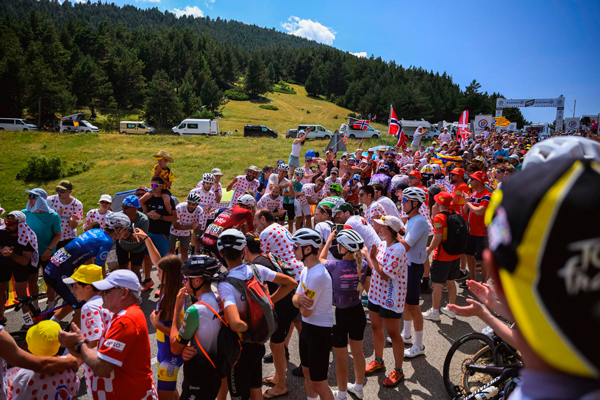
This the race report for Stage 3 Tour de France 2026.
These are video highlights of Stage 3.
Race Details | Poll | Map & Profile | Timings | Videos | Food & Drink | Route Notes | Favourites
| Date | Monday 6th July 2026 |
|---|---|
| Stage classification | Mountain |
| Distance | 195.9km |
| Intermediate sprint | Campdevanol |
| Climbs | Côte de Sant Feliu de Codines (Cat. 3) Col de Toses (Cat. 1) Col du Calvaire (Cat. 3) Les Angles (Cat. 3) |
| Total climbing | 3,850m |
Vote for one of the main contenders to win Stage 3.
This is a map of the route of Stage 3, Tour de France 2026.

This is the profile of Stage 3 Tour de France 2026.

| Caravan | Fast Schedule | Slow Schedule | |
|---|---|---|---|
| Start Time (départ fictif) | 0955 |
1210 |
1210 |
| Start Time (départ réel) | 1005 |
1220 |
1220 |
| Intermediate Sprint Campdevanol | 1259 |
1436 |
1450 |
| Col de Toses Climb | 1350 |
1523 |
1543 |
| Finish Line (195.9km) | 1551 |
1654 |
1723 |

Get the official Tour de France 2026 Race Guide.
The fully authorised guide includes detailed stage maps, team profiles, expert analysis and stunning photography.
Available in Standard and Premium Editions.

Get a bundle with the premium race guide, Cycling Plus Ride Like a Pro, plus socks, coasters and an allen key, for £26.38.

This is a video of the route of Stage 3 Tour de France 2026.
This video shows summertime activities in Les Angles.

Stage 3 of the Tour de France 2026 is from Granollers to Les Angles, in the Pyrénées-Orientales département.
In Les Angles, you could eat at Chez Antoine Martin, who offers authentic and traditional Catalan cooking.
In what I suspect is a machine translation of the original French, one Tripadvisor reviewer says, 'In the "come hungry" series, we keep a bestseller. An appetizer of scallop nuts that would make some dishes of the same name pale from other establishments, a magical side of beef, gargantuan desserts, all cooked finely, happiness. Add a team on top'.
Anyway, grilled meat seems to feature heavily.
Wikipedia tells me that Catalan cuisine also relies on Mediterranean ingredients, including fresh vegetables, tomato, garlic, aubergine, beans and mushrooms.
It features pork (inland) and seafood (along the coast). Catalan-style cod with raisins and pine nuts sounds nice.
Crema catalana, made from egg yolk, milk and sugar, is a well-known dessert.
I suggest a Bastide Esteva Côtes Catalanes wine to accompany your food (affiliate link).
The stage starts in Granollers (départ fictif).

Granollers is around 30km north east of Barcelona, and there's no escaping the feeling that it was chosen because it gets the peloton a bit closer to France, where they are heading today.
It's the capital of the comarca of Vallès Oriental. It stands on the Congost river.
In the 1800s, this was a textile town. Now, it's a bustling business centre.

The départ réel is on the C-1415b at Can Ballestà, just west of Granollers.
The riders make their way north to Sant-Feliu-de-Codines.

This is the first categorised climb on the stage - the Côte de Sant-Feliu-de-Codines.
It is 7.6km at an average gradient of 4.5%. It might serve as the launchpad for the day's breakaway.
Sant-Feliu-de-Codines is known for a warm, dry climate which is considered beneficial to valetudinarians.
Stage 3 continues to Centelles, on the river Congost.

Now the race route heads for Vic, which is a significant town.

Vic is the capital of the comarca of Osona. It is in the Plain of Vic, about half way between Barcelona and the Pyrenees.
It gets its name from the Latin Vicus Ausonae, where vicus means a town that grew up next to a Roman fort - so in effect, it is just called 'town'.
It is known for temperature inversions in Winter, producing persistent fog.
Vic has a history of Basque separatist sentiment.
Spanish philosopher Jaume Balmes is buried in Vic.
The race heads relentlessly north, following the river Ter to Ripoll.

A Benedictine monastery in Ripoll, Santa Maria de Ripoll, was founded in 879.
Because there was coal and iron ore here, there was metal-working industry from the early Middle Ages. Later, Ripoll produced nails, crossbows and guns.
Ripoll has a significant Moroccan population - people who arrived to work in factories in the 1990s.
Soon after Ripoll is Campdevànol.
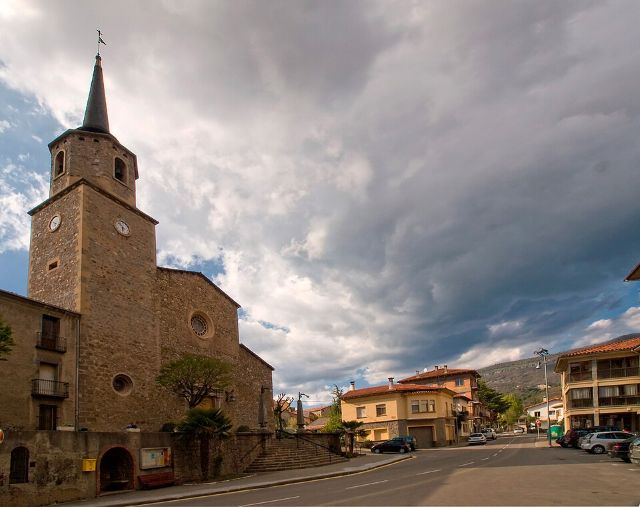
The intermediate sprint is at Campdevànol.
The race route then passes through Ribes de Freser and starts to climb to Planoles.
Next, the riders head west and climb to the Col de Toses.

The Col de Toses (the name given to it by the French race organisers), or Collada de Toses, is the second categorised climb today.
It is 9.3km at an average 6.5%.

Skiing Made Easy is a practical guide to learning to ski based on many happy seasons of ski teaching.
It takes you through the beginner's progression from snowplough to parallel turns, starting at the very beginning and not assuming any prior knowledge.
The book suggests relevant exercises to develop and improve your skills. Common faults are identified, along with the best ways to correct them.
'By the way' sections contain information about many of the little things that people assume you just know, but you may not.
'This is the book I wish I'd had when I started skiing' - reviewer on Amazon.
How to buy:

Skiing Made Easier is the follow-up to Skiing Made Easy, and picks up from where the first book left off.
The first chapter is Refining Your Parallel Turns.
The chapters on ski technique beyond basic parallel turns are Carving, Short Turns, Bumps and Off Piste.
There are then further chapters on Avalanche and Mountain Safety, Ski Psychology, Physical Preparation, Ski Servicing and Alpine Wildlife.
As in Skiing Made Easy, common faults are identified and exercises suggested to correct them and to develop your skills.
'By the way' passages contain bits of skiing knowhow that could otherwise take years to pick up.
How to buy:
The Amazon URLs are affiliate links.
Soon after the descent starts, the riders go through La Molina.

La Molina is the main ski village of a resort called Alp 2500. Spain's first ski lift opened here in 1943, and its first ski school opened in 1944.
Dan Martin won Stage 3 of the Volta a Catalunya here in 2016.
The descent is to Puigcerdà.

Very soon, the race leaves Spain and enters France.
The road rises to Font-Romeu and the Col de Calvaire (1,836m).

The climb to the Col du Calvaire is 11.4km at an average 4.1%. The
summit comes after 172.3km raced.
Then the route is undulating as the riders head past the Aérodrome de Mont-Louis La-Quillane to the Lac de Matemale.

That just leaves the final short climb to Les Angles.
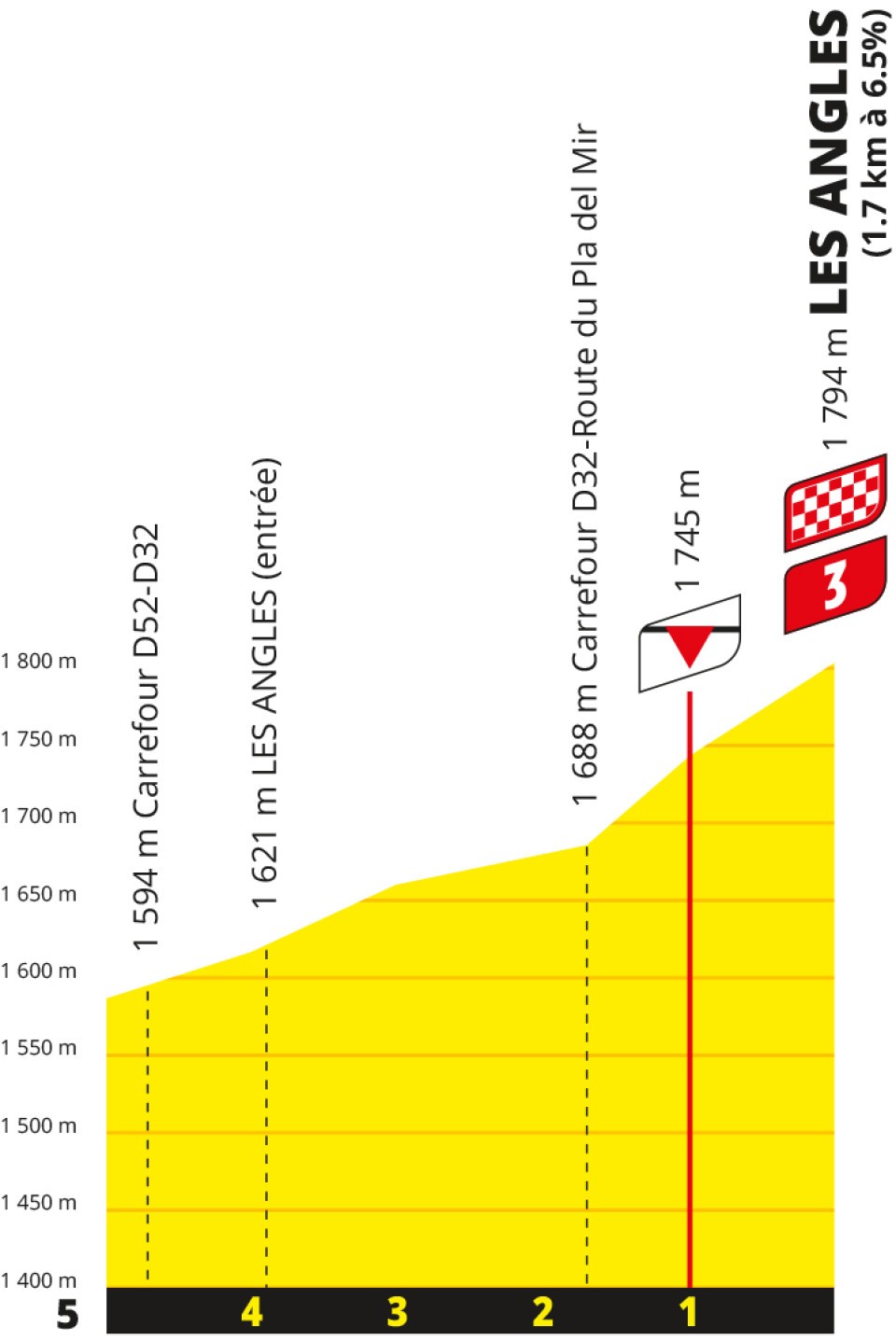
Stage 3 ends with a 1.7km climb at an average 6.5% gradient to Les Angles.

The finish town is the ski resort of Les Angles.
The only thing Wikipedia says about this place is that in the 1300s, the Black Death wiped out the entire population except for two sisters - a fact which is more interesting than cheerful.
The Les Angles tourist office says that the ski resort was created in 1964 by Paul Samson.
There are now 60km of ski pistes, and you can ski right back to the clock tower in the village.

If Christian Prudhomme is right to say that Stage 3 will be one for the breakaway, perhaps Ben Healy or Valentin Paret-Peintre will be in it and contesting the win - as they did on Mont Ventoux in 2025.
Alternatively, Pogacar could gobble up yet another stage.
Who do you think will win Stage 3 of the 2026 Tour de France?

Price £84.99 from Amazon at the time of writing (affiliate link).
As an Amazon Associate, I can theoretically earn a small commission from qualifying purchases.

Bike Rides in the Yorkshire Dales is available in colour paperback.
Find out more about Bike Rides in the Yorkshire Dales or buy a copy.

Bike Rides In and Around York features a historical city tour, plus family rides, road rides, and mountain bike rides.
Find out more about Bike Rides In and Around York or buy a copy.

Bike Rides in Harrogate and Nidderdale is a book of family, mountain and road bike rides.
Find out more about Bike Rides in Harrogate and Nidderdale or buy a copy.

Find out more about Mountain Bike Rides in the Yorkshire Dales.
Buy Mountain Bike Rides in the Yorkshire Dales at £8 + P&P.

Garmin Edge Explore, £197.99 at the time of writing.
Garmin Edge Explore on Amazon (affiliate link).

Faster by Michael Hutchinson on Amazon (affiliate link).


