Cycling in Yorkshire & Beyond

Cycling in Yorkshire & Beyond

Stage 4 of the Tour de France 2026 is a 181.9km hilly stage from Carcassonne to Foix.
The climbs are the Col de Coudons and the Col de Montségur. The Col de Montségur is 35km from the finish, and the leading group over the top will contest the stage win.
It could be a breakaway, or it might be a reduced peloton containing the sprinters-who-can-climb.
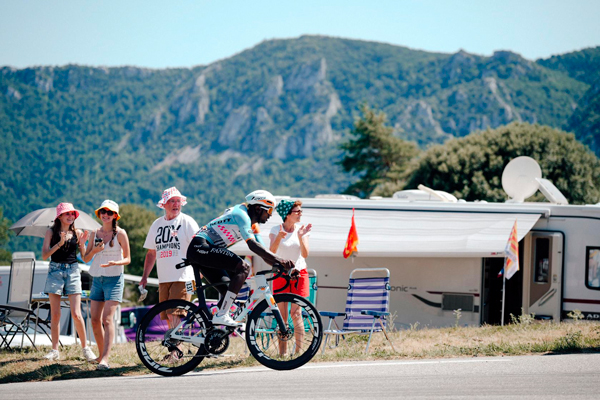
This is the race report for Stage 4 Tour de France 2026.
These are video highlights of Stage 4.
Race Details | Poll | Map & Profile | Timings | Videos | Food & Drink | Route Notes | Favourites
| Date | Tuesday 7th July 2026 |
|---|---|
| Stage classification | Hilly |
| Distance | 181.9km |
| Intermediate sprint | Quillan |
| Climbs | Col de Bedos (Cat. 4) Col du Paradis (Cat. 3) Col de Coudons (Cat. 2) Col de Montségur (Cat. 2) |
| Total climbing | 2,700m |
Vote for one of the main contenders to win Stage 4.
This is a map of the route of Stage 4, Tour de France 2026.

This is the profile of Stage 4 Tour de France 2026.

| Caravan | Fast Schedule | Slow Schedule | |
|---|---|---|---|
| Start Time (départ fictif) | 1055 |
1310 |
1310 |
| Start Time (départ réel) | 1110 |
1325 |
1325 |
| Intermediate Sprint | 1323 |
1523 |
1534 |
| Col de Montségur Climb | 1439 |
1641 |
1701 |
| Finish Line (181.9km) | 1530 |
1723 |
1747 |

Get the official Tour de France 2026 Race Guide.
The fully authorised guide includes detailed stage maps, team profiles, expert analysis and stunning photography.
Available in Standard and Premium Editions.

Get a bundle with the premium race guide, Cycling Plus Ride Like a Pro, plus socks, coasters and an allen key, for £26.38.

This is a video of the route of Stage 4 Tour de France 2026.
Stage 16 of the 2022 Tour de France finished in Foix.
Stage 15 of the 2025 Tour de France finished in Carcassonne.

Stage 4 is from Carcassonne in the Aude département to Foix in the Ariège.
Food in this area is dominated by meat and poultry. Cassoulet is a dish with white beans, pork, duck, lamb and Toulouse sausage. It is cooked slowly and served in a bowl.
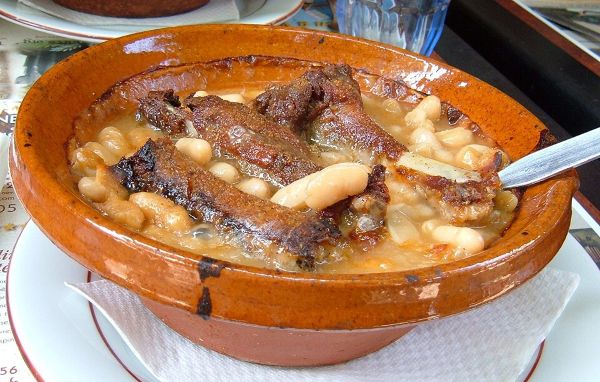
Cassoulet is a speciality of Carcassonne, as are truffles, which are sold on the local market.
Croustade aux pommes is an apple pie with apples flambéed in Armagnac.
Madiran is a local red wine made from Tannat and other grapes.
Buy a bottle of Madiran wine (affiliate link).
The stage starts in Carcassonne (départ fictif).

Carcassonne is a town of about 45,000 people in the département of the Aude, on the river Aude and the Canal du Midi. It's dominated by the Medieval château surrounded by ramparts, la Cité de Carcassonne.
According to legend, it got its name from Carcas, the wife of a Saracen king. The Saracens in the city were besieged by Charlemagne. The king of the Saracens was captured and put to death. His wife, Carcas, continued to hold out. Her soldiers were dying of starvation, so she put scarecrows on the ramparts, and changed their hats every 2 hours, to make it look as though the sentries were changing over. Then she killed the last remaining pig, stuffed its belly with the last of the corn, and threw it over the walls. When it landed, the belly burst open to reveal the corn.
Charlemagne's soldiers were amazed. They thought that even after the long siege, the Saracens were feeding their pigs with corn. Defeated, they packed up and began to leave.
Carcas had the victory trumpets sounded, and Charlemagne's soldiers said 'Ecoutez, Carcas sonne' (listen, Carcas is sounding [the trumpets]). So the town got its name. Probably.
Carcassonne started as a Roman camp in the C1st AD. The Visigoths captured it as the Roman Empire crumbled, and it became part of the Visigoth kingdom of Toulouse. In 725, the Saracens took it from the Visigoths, and in 759, the Saracens were defeated by the Franks, under Pepin the Short.
Carcassonne belonged to the Counts of Toulouse, within the Frankish Empire, from the 800s to the 1200s.
Peace and prosperity was disrupted from 1208, with the Albigensian Crusades. Catharism was a dualistic form of Christianity: according to the Cathars, there was a spiritual world ruled by God, and a material world governed by Satan. Cathars were regarded as heretics by the Roman Catholic church. When a Papal legate was assassinated in 1208, the Pope began a Crusade against the Cathars in the south west of France. In 1209, the Viscount of Carcassonne was defeated by Simon de Montfort.
The King of France exiled the inhabitants of Carcassonne for 7 years, and at the end of this time, he allowed them to build a fortified new town, or ville bastide, known as the Ville Basse (to the west of the river Aude), and to repair and strengthen the original fortress (to the east of the Aude). The fortress to the east of the river is what is known as la Cité de Carcassonne, and is the largest Medieval fortress in Europe. It was restored by Viollet-le-Duc in the C19th.
La Cité has a double curtain wall, with 14 towers on the outer wall, and 24 towers on the inner wall. Inside is the C12th Château Comtal, which was the home of the viscounts of Carcassonne, and the Basilique Saint-Nazaire, begun in 1096 in a Romanesque style, and completed in the 1200s and 1300s in a Gothic style.

Verse 1
Je me fais vieux, j'ai soixante ans ;
J'ai travaillé toute ma vie,
Sans avoir, durant tout ce temps,
Pu satisfaire mon envie.
Je vois bien qu'il n'est ici bas
De bonheur complet pour personne.
Mon voeu ne s'accomplira pas :
Je n'ai jamais vu Carcassonne.
Verse 2
On voit la ville de là-haut,
Derrière les montagnes bleues :
Mais pour y parvenir il faut,
Il faut faire cinq grandes lieues ;
En faire autant pour revenir !
Ah ! si la vendange était bonne !
Le raisin ne veut pas jaunir :
Je ne verrai pas Carcassonne.
Verse 3
On dit qu'on y voit tous les jours,
Ni plus ni moins que les dimanches,
Des gens s'en aller sur les tours,
En habits neuf, en robes blanches,
On dit qu'on y voit des châteaux
Grands comme ceux de Babylone,
Un évêque et deux généraux !
Je ne connais pas Carcassonne !
Verse 4
Le vicaire a cent fois raison.
C'est des imprudents que nous sommes,
Il disait dans son oraison
Que l'ambition perd les hommes.
Si je pouvais trouver pourtant
Deux jours sur la fin de l'automne...
Mon Dieu que je mourrai content,
Après avoir vu Carcassonne !
Verse 5
Mon Dieu, mon Dieu, pardonnez-moi
Si ma prière vous offense ;
On voit toujours plus haut que soi,
En vieillesse comme en enfance.
Ma femme avec mon fils Aignan,
A voyagé jusqu'à Narbonne :
Mon filleul a vu Perpignan.
Et je n'ai pas vu Carcassonne !
Verse 6
Ainsi chantait, près de Limoux,
Un paysan courbé par l'âge.
Je lui dis: 'Ami, levez-vous,
Nous allons faire le voyage'
Nous partîmes le lendemain ;
Mais - que le Bon Dieu lui pardonne -
Il mourut à moitié chemin.
Il n'a jamais vu Carcassonne.
Il ne verra pas Carcassonne.
Gustave Nadaud
The départ réel is to the east south east of Carcassonne near Trèbes.
Stage 4 sets off heading south east on the D3, passing through Fontiès-d'Aude, Monze and Pradelles-en-Val. At Pradelles it is at the foot of the Montagne d'Alaric.

The race continues on the D3 and reaches the village of Lagrasse.

Next there's a climb from the Orbieu river up to the Col de Villerouge (404m).

The descent is to Villerouge-Termenès.

The last Cathar 'perfect', Guillaume Bélibaste, was burnt at the château in Villerouge-Termenès in 1321.
The next little climb on the route is to the Col de Bedos (485m).

It is 3.3km at an average 4.4%, to a height of 485m.
The road (the D613) continues through the villages of Laroque-de-Fa and Mouthoumet, and climbs once again to the Col du Paradis (622m).
The climb of the Col de Paradis is 5.8km at an average 4.1%.
Now there's a descent alongside a stream called the Sals, through Arques, and reaching the Aude river at Couiza.
The race continues on the D118 by the river past Espéraza to Quillan.

The intermediate sprint is at Quillan.
Quillan was a stopping point on the ancient road between Carcassonne and Perpignan.
The town was known for hat-making, and later production of formica. Now it focuses on eco-tourism, with outdoor pursuits such as hiking, biking and kayaking.
A local sparkling wine is Blanquette de Limoux.

Buy a case of six bottles of Blanquette de Limoux (affiliate link).

How to Write a Kindle Ebook is a step by step guide to writing and publishing an ebook on Amazon.
It takes you through the process of writing and formatting it using Microsoft Word, then uploading it to Kindle Direct Publishing and selling it on Amazon.
There's advice and guidance at every stage, with examples including screenshots, and tips on how to overcome practical problems you're likely to encounter.
How to Write a Kindle Ebook will be your reliable and trusted companion as you write and publish your own book.
'I find this a really helpful and informative guide to e-book writing and recommend to others' - reviewer on Amazon.
Buy the ebook or the paperback on Amazon.
After Quillan, the riders tackle the first categorised climb of the day, the Col de Coudons.

The Col de Coudons is 10.7km at an average 5.5% to a height of 883m.
It leads to the Plateau de Sault, shown in the image above; 20km of the stage are up on the plateau.
The descent is via the Col de la Croix des Morts to Bélesta.

Next the race route climbs again, this time on the D9 to Montségur.

The Col de Montségur comes just after the village of Montségur.
The climb is 6.9km at an average 6.6%, and to a height of 1,059m at the top.
The Château de Montségur (1,207m) overlooks the col. It was here on the mountain (or 'pog') that the Cathars had a stronghold, but after a siege in 1244 the forces of the Pope took it. Over 200 Cathar 'perfects' were then burned alive at the foot of the mountain.
The current castle is from a later period.

The descent is to Lavelanet.

The name Lavelanet comes from the Latin avellana, meaning hazel nut.
Lavelanet was known for textile production from very early times. The Roman Emperor Caracalla had cargoes of cloth transported from Lavelanet to Rome.
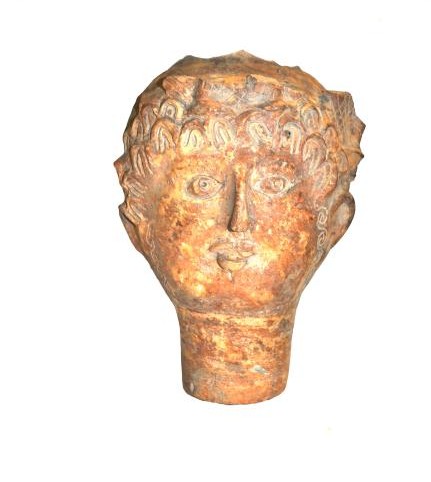
Stages of the Tour de France started in Lavelanet in 2002 and 2008.
From Lavelanet it's 26km along the D10 and D1 to the Ariège river and to Foix.
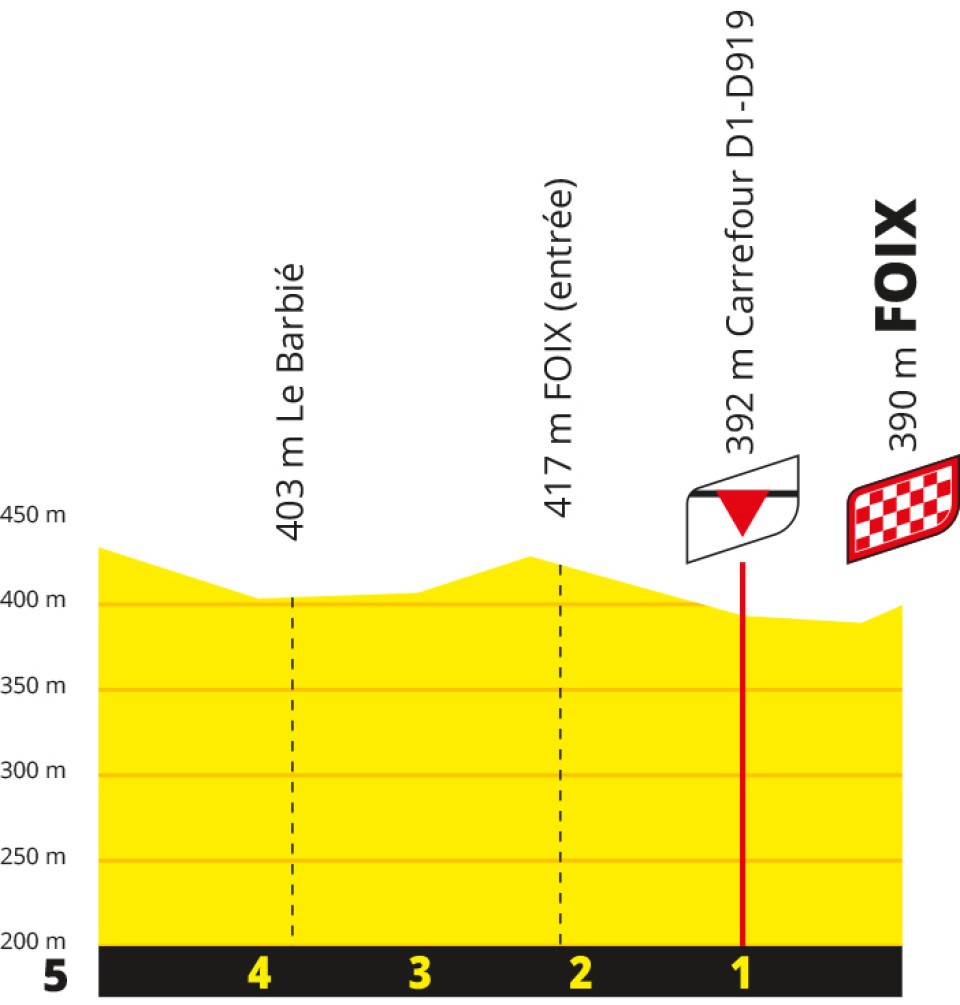
The finale of Stage 4 is largely downhill from Lavelanet to Foix.
The D1 arrives north of Foix, then turns south (the D1 Avenue Georges Clemenceau) to head towards a junction with the D919.
On the D919 the riders follow the river Ariège, then turn right to cross it on the D117 Cours Gabriel Fauré.
The finish line is on the Cours Gabriel Fauré, in front of the tourist office and the Passéjade gardens.

Foix is a significant town of 9,721 people. It was the historic capital of the Comté de Foix, and is now the capital of the Ariège département.
The Romans were the first to build a fort on the rocky outcrop where the Château de Foix now stands. In the Middle Ages, the town grew around an Abbey (founded in the C9th) and the château (the first iteration of which was built in the C10th).
Foix is twinned with Ripon in North Yorkshire.

The favourites for Stage 4 could include Classics and all-round riders like Mathieu van der Poel.
If not MVDP, then maybe this could be a day for a sprinter-who-can-climb like Mads Pedersen.
Who do you think will win Stage 4 of the 2026 Tour de France?

Price £84.99 from Amazon at the time of writing (affiliate link).
As an Amazon Associate, I earn from qualifying purchases.

Bike Rides in the Yorkshire Dales is available in colour paperback.
Find out more about Bike Rides in the Yorkshire Dales or buy a copy.

Bike Rides In and Around York features a historical city tour, plus family rides, road rides, and mountain bike rides.
Find out more about Bike Rides In and Around York or buy a copy.

Bike Rides in Harrogate and Nidderdale is a book of family, mountain and road bike rides.
Find out more about Bike Rides in Harrogate and Nidderdale or buy a copy.

Find out more about Mountain Bike Rides in the Yorkshire Dales.
Buy Mountain Bike Rides in the Yorkshire Dales at £8 + P&P.

Garmin Edge Explore, £197.99 at the time of writing.
Garmin Edge Explore on Amazon (affiliate link).

Faster by Michael Hutchinson on Amazon (affiliate link).


